H. Pylori Infection- Symptoms, Causes & Natural Remedies
An H. Pylori infection can cause symptoms that may be dismissed or confused with those of other conditions. Informing yourself and becoming aware of this condition can help alleviate the infection and clear symptoms.
This post contains affiliate links. This means I may earn a small commission when you purchase through my link, at no additional cost to you. You can read my full disclosure policy here.
Are you tired of trying to match the symptoms you are experiencing to an infection or other ailing condition?
This may be because infections and conditions often compound. Beginning somewhere is the key.
When you have unusual, persistent, and concerning problems, begin researching credible websites and sources, and listen to or speak with knowledgeable professionals (preferably holistic or integrative) to find valuable information.
Many symptoms do overlap. Therefore, do not rush into conclusions. And many times, a few lifestyle adjustments can help heal more than one condition at a time.
What is H. Pylori
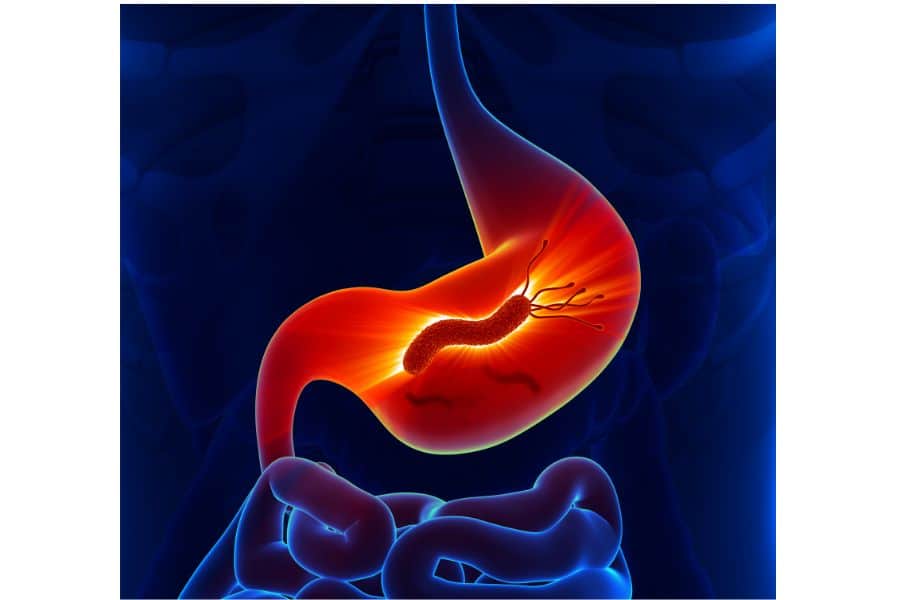
H. Pylori (Helicobacter pylori) is a spiral-shaped bacterium (gram-negative) that attaches itself to a host. It is found in deep tissue environments, specifically the gastric glands and lining of the stomach.
The bacteria flourish in this environment due to low concentrations of oxygen. High levels of oxygen cause enzymatic damage to the bacteria, killing them.
An H. Pylori infection is complex. The colonization of this bacterium disrupts the gastric microenvironment, causes cell damage, and interferes with internal barriers. Overall, it interferes with the natural environment of the stomach.
This condition is a challenging health concern affecting up to 50% of individuals worldwide. The exact percentage is dependent on where you live, with a lower percentage range for the U.S. population speculated at around 30-40 percent.
What Causes H. Pylori
Unfortunately, this answer is not a simple one. However, certain conditions create a favorable environment for H. pylori to infect and exist.
A weakened immune system creates a more favorable environment for Helicobacter pylori to invade and take hold. Therefore, diseases, illnesses, toxin exposure, and other infections can make a person more susceptible to a H. pylori infection.
Mold toxicity, for instance, is one of these conditions. Mold weakens the immune system and disrupts gut health, creating a more favorable atmosphere for H. Pylori. This is what caused my family and me to become infected with this bacterium.
Other autoimmune conditions, SIBO, and leaky gut are all possibly intertwined with an H. Pylori infection. However, not everyone has these conditions when they are infected with H. Pylori.
But a greater chance exists that there is an overlap of infections and symptoms, according to research. Please see my references below for further information.
Symptoms of Helicobacter pylori
- Low or high stomach acid levels - dependent on inflammatory conditions
- Nauseousness after eating
- Increase in cavities or tooth decay
- Loss of appetite
- Bloating
- Feeling full after eating only a little
- Stomach pain or discomfort, possibly waking you at night
- Indigestion or acid reflux (may create a lot of burping)
- Gastric ulcers
- Extreme fatigue
- Lack of sleep and/or poor sleep quality
- Easily stressed or lower ability to manage it well
- Lower platelet cells and a higher risk for nose bleeds, bruising, and increased wound bleeding
- iron-deficiency and/or iron-deficiency anemia
Treating an H. Pylori Infection
Antibiotics can be used to treat H. pylori bacteria. However, resistance to antibiotics is often common, making alternative treatment appealing.
Additionally, antibiotic use can disrupt the microbiome, creating other problems. If you choose to go the antibiotic route, drug-susceptibility testing is recommended to focus on antibiotic-resistant strains.
I prefer to use the holistic alternatives that are available. When choosing the holistic route, it is essential to consider that the healing process depends on the individual's existing conditions, ailments, and other factors.
This bacteria can be alleviated through the proper course of disciplined holistic treatment. Research indicates the following options are effective in H. Pylori treatment. These options work synergistically to heal the body from this bacterial infection.
Natural Remedies For H. Pylori

Bees are amazing. Their hive and honey formation process provides us with numerous elements for healing and preventive care. Propolis is one of these elements.
Propolis is the mixture of compounds created by bees to build their beehive. This sterile mixture surrounds the walls of the beehive, keeping it safe from germs.
Research shows that propolis maintains its cellular structure and effectiveness when consumed. Propolis extract suppresses the free radicals produced by H. Pylori, specifically the compound Xanthine oxidase.
Xanthine oxidase can cause both inflammation and tissue damage. This makes propolis a valuable treatment against H. Pylori.
Propolis targets H. Pylori through various pathways, working together synergetically. It is shown to promote the healing of ulcers, enhance the stomach barrier, alleviate oxidative stress created from these harmful bacteria, and help to regulate dysbiosis in the gut microbiome.
Additionally, propolis contains over 300 compounds beneficial to the body, high amounts of antioxidants, minerals and vitamins, magnifying its immune system benefits.

Garlic contains the compound allicin. Evidence shows this sulfur-containing compound to be a valuable natural treatment option for H. Pylori. Garlic oil and allicin found in garlic exhibit a broad range of antibacterial effects.
The biggest obstacle this supplement faces in treating H. Pylori is the PH level of the stomach. Acid is an enemy of allicin's effectiveness against this bacterium.
The reason for this is that stomach acid affects allicin's stability and lowers its sulfur component. However, according to studies testing allicin's effectiveness on H. pylori, garlic proves successful in treating Helicobacter pylori regardless of stomach acid production.
This makes garlic extract a great natural option due to its lack of side effects. Also, the fact that proton pump inhibitors are not used in comparison to antibiotic treatments makes it an even more appealing treatment option.

Curcumin, the element that gives turmeric its yellow pigment, is recognized for its anti-inflammatory effects as well as other pharmaceutical benefits. We use turmeric and curcumin consistently because their effects are noticeable.
Therefore, it may not come as a surprise that studies verify that curcumin effectively reduces inflammation induced by H. pylori. There was a decrease in oxidative stress damage, and in some instances, showed levels consistent with those of non-infected H. pylori species.

Another beneficial herb/spice for gastrointestinal health is ginger. It has been used to assist many digestive ailments over the years.
Research demonstrates ginger's usefulness against Helicobacter pylori in several ways. Some of these include protecting DNA from damage, lowering oxidative stress damage, and taking preventative measures against the invasion of this bacterial infection.

The intake of cranberries may help the body defend itself and heal from the bacterial infection H. pylori as well. This is due to cranberries' attributes, such as proanthocyanidins, preventing the bacteria from taking hold in the stomach or mucous lining.
Addtionally, these compounds stop this infectious bacteria from creating a biofilm, which H. pylori forms to strengthen and protect itself in the stomach. Cranberry is also a valuable holistic treatment because it suppress and kills certain strains of H. pylori altogether.

Licorice is another beneficial treatment option for combating an H. pylori infection. This is because all strains of Helicobacter pylori have been identified as being affected by this herb.
Also, it has shown positive results with people having an ulcer or other gastrointestinal distress due to Helicobacter pylori. Normal bacterial flora are not affected by the use of licorice, just the same as the other natural treatment options listed above.
If you choose to take licorice as part of a treatment plan against H. pylori and have high blood pressure, then make sure it is DGL or consult a doctor first. This is the supplement form of licorice root that has the component removed that can cause high blood pressure. Additionally, do not take it if pregnant.

Lastly, mastic gum, also known as Pistacia lentiscus, is an effective natural remedy in the treatment of an H. pylori infection. Mastic is extracted from a Mediterranean evergreen shrub known as the mastic tree.
Mastic gum, even at low concentrations, is shown to successfully fight this infectious bacterium. All strains showed a noticeable reduction in bacterial growth when studied.
Additionally, this natural supplement weakens H. Pylori by changing the structure of the bacteria. Mastic gum's strong antibacterial properties help researchers understand why it works so well to heal stomach ulcers, a frequent result of an H. pylori infection.
It is shown that the greatest benefits of using mastic gum peaks at about one month. Therefore, if you plan to use this, keep this in mind.
Apple peel, carrot seed oil and oolong tea are more natural options to explore, all showing positive results for combating an H. pylori infection.
- https://www.ncbi.nlm.nih.gov/books/NBK534233/
- Wafa A. Aldhaleei, MBBCh, MSc, MPH, Michael B. Wallace, MD, MPH, Dana M. Harris,MD and Yan Bi, MD, PhD Cleveland Clinic Journal of Medicine August 2024, 91 (8) 481-487; DOI: https://doi.org/10.3949/ccjm.91a.24031
- https://pmc.ncbi.nlm.nih.gov/articles/PMC9952126/
- Cardos, I. A., Zaha, D. C., Sindhu, R. K., & Cavalu, S. (2021). Revisiting Therapeutic Strategies for H. pylori Treatment in the Context of Antibiotic Resistance: Focus on Alternative and Complementary Therapies. Molecules (Basel, Switzerland), 26(19), 6078. https://doi.org/10.3390/molecules26196078
- Baker D. A. (2020). Plants against Helicobacter pylori to combat resistance: An ethnopharmacological review. Biotechnology reports (Amsterdam, Netherlands), 26, e00470. https://doi.org/10.1016/j.btre.2020.e00470
- Kondakindi Venkateswar Reddy, Nalam Renuka Satya Sree, Pabbati Ranjit, Naga Raju Maddela, Vivek Kumar, Priyanka Jha, Ram Prasad, Matteo Radice,
Essential oils, herbal extracts and propolis for alleviating Helicobacter pylori infections: A critical view,
South African Journal of Botany, Volume 157, 2023, Pages 138-150, ISSN 0254-6299 - Nie, H.; Li, Q.; Zhao, K.; Li, W.; Zhang, C.; Jiang, X. Potential Efficacy of Propolis in Treating Helicobacter pylori Infection and Its Mechanisms of Action. Nutrients 2025, 17, 2803. https://doi.org/10.3390/nu17172803
- García, M. T., Garcia-Vargas, J. M., Fernández, L. A. G., Cuevas, P., & Gracia, I. (2023). Garlic Extracts: Effect of pH on Inhibition of Helicobacter pylori. Life (Basel, Switzerland), 13(7), 1434. https://doi.org/10.3390/life13071434
- Zardast, M., Namakin, K., Esmaelian Kaho, J., & Hashemi, S. S. (2016). Assessment of antibacterial effect of garlic in patients infected with Helicobacter pylori using urease breath test. Avicenna journal of phytomedicine, 6(5), 495–501.
- Vetvicka, V., Vetvickova, J., & Fernandez-Botran, R. (2016). Effects of curcumin on Helicobacter pylori infection. Annals of translational medicine, 4(24), 479. https://doi.org/10.21037/atm.2016.12.52
- https://iadns.onlinelibrary.wiley.com/doi/10.1002/fft2.47
- World J Gastrointest Pharmacol Ther. May 6, 2016; 7(2): 171-178 Published online May 6, 2016. doi: 10.4292/wjgpt.v7.i2.171 Shmuely H, Domniz N, Yahav J. Non-pharmacological treatment of Helicobacter pylori. World J Gastrointest Pharmacol Ther 2016; 7(2): 171-178 [PMID: 27158532 DOI: 10.4292/wjgpt.v7.i2.171]
- Momeni, A., Rahimian, G., Kiasi, A., Amiri, M., & Kheiri, S. (2014). Effect of licorice versus bismuth on eradication of Helicobacter pylori in patients with peptic ulcer disease. Pharmacognosy research, 6(4), 341–344. https://doi.org/10.4103/0974-8490.138289
Mastic Gum Kills Helicobacter pylori, Farhad U. Huwez, Debbie Thirlwell, Alan Cockayne, et al, The New England Journal of Medicine, Massachusetts Medical Society, Dec 24, 1998
More Interesting Posts for your health
Bloating, gassy, crampy, or irritated often? Sick of looking like you are pregnant when you are not? This list will show you the best herbal tea for gut health. A better functioning digestion system will
Being anxious and depressed is a difficult state to be in. Knowing these 10 common deficiencies that cause anxiety and depression can help you get on the right track to feeling better. Become calmer and
Mold toxicity symptoms are life-changing and not in a good way. They can impact the health of you and your loved ones and create a wide-range of problems. Learning about the symptoms and best ways
This post discusses 7 profound Omega 3 fish oil health benefits. These fatty acids are extremely helpful to the way the body functions and have minimal to no side effects. From joint and cardiovascular health
Mold prevention is a MUST for keeping your living space safe. There are many factors that come in to play as to why mold will develop in a space. But if you are in need
A liver that is not functioning properly is setting the body up for a host of health challenges. The following processes deliver ways you can help liver function as well as help heal and maintain
Identifying a H. pylori infection is helpful in identifying your body's needs to heal. Using the information that you learn here to further explore
Last Updated on 10 months ago by Amy
