9 Naturally Effective Herbal Teas For Sore Throat
Need a soothing sore throat remedy? Using these specific herbal teas for sore throat relief will not disappoint you. They support the healing process and provide comfort all in one.
This post contains affiliate links. This means I may earn a small commission when you purchase through my link, at no additional cost to you. You can read my full disclosure policy here.
Tea is a great way to utilize herbals and get healing underway. The medicinal properties of the herbs are further activated when infused in very warm water.
Consider combining herbals for a Synergistic effect. This means the herbs' properties have a more powerful effect, and you can receive enhanced effects.
The warmth from drinking tea is also comforting for a sore throat. It will provide the body with vitamins and minerals, which are needed to aid the immune system in healing the body.
Additionally, you may have difficulty swallowing or eating in the midst of a sore throat, so these nutrients from the herbs are really important.
Herbal Teas For Sore Throat
Ginger Root
Ginger is a common ingredient used in cooking, baking and herbal remedies. Studies show it to be useful in the treatment of bacterial and viral infections concerning oral and respiratory health.
Also, ginger root is a strong anti-inflammatory herb thanks to the helpful compounds it contains, two of then being gingerol and zingeron. It is used frequently to treat the flu and colds.
Additionally, its polysaccharides, terpene compounds and organic acids make it an invaluable remedy in clearing mucous, reducing free radicals, reducing inflammation and reducing infection.
However, this spice goes a long way in flavor. Therefore, add it to other ingredients when blending the flavor into a tea, and be mindful of the zesty taste it may add if used as a ginger tea alone.
Mullein
I absolutely love mullein. It is a powerful herb that works wonders for colds and sore throats. Its expectorant properties go to right to work, breaking down mucous related to a sore throat.
Mullein is a nutrient-rich herb that helps with throat irritations by soothing mucous membranes. It contains many minerals and vitamins, including B vitamins, vitamin C, selenium, zinc, magnesium, and calcium, to name a few.
The nice thing about this herb is that it also contains antiseptic qualities. That means it fights germs and is preventative against new threats.
Lastly, Mullein offers an earthy flavor profile. The flavor provides an undertone when mixed into tea blends.
Chamomile Tea
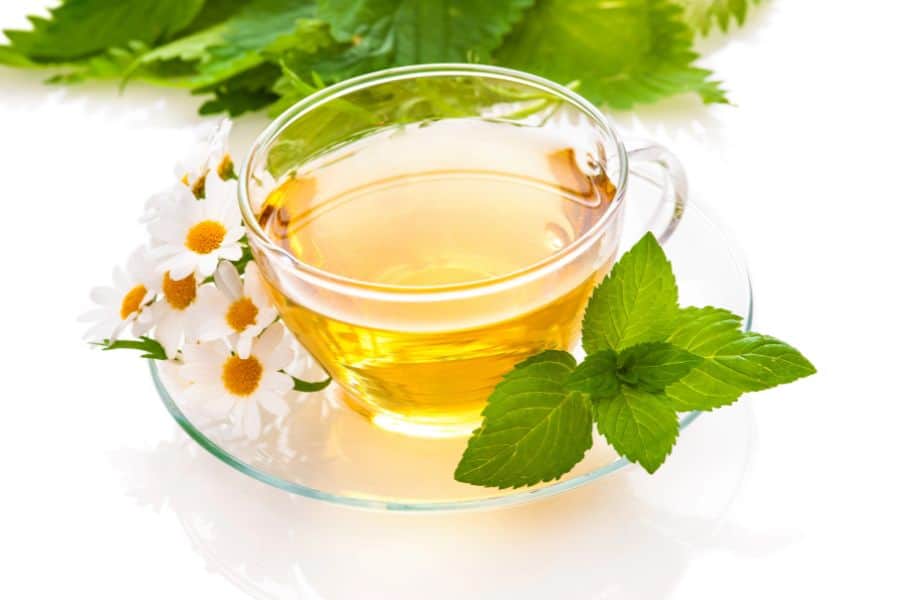
The calming effects of chamomile are well-known. This attribute extends its positive effects when soothing sore throat pain.
Chamomile has been shown to lubricate the throat, preventing and helping with hoarseness that comes with having a sore throat. Additionally, it calms irritated tissue, aiding in the repair process.
Its anti-inflammatory properties naturally work to reduce swelling and inflammation associated with cold symptoms.
Chamomile's pleasant, mild flavor profile pairs well with many herbs.
Slippery Elm
Slippery elm's inner bark is another natural remedy used in traditional medicine for sore throat symptoms. It increases saliva production, decreasing the dryness of the throat.
The active main ingredient in the inner bark of slippery elm is mucilage (thick and gummy, jello-like matter). This coats the mucous membranes, relieving a scratchy throat.
It is easy to incorporate into many teas to provide an extra healing layer.
Rose Hips
According to research, the herb rose hips can reduce the symptoms of a common cold, including colds accompanied by a sore throat.
Rose hips contain high amounts of Vitamin C, a well-known fighter of cold and flu symptoms. The herb also contains natural compounds and antioxidants that subdue pain and inflammation.
Rose hips have a nice, light, floral taste. It offers Vitamins A, E, and minerals too.
Licorice Root
Licorice tea is often used as a holistic aid in the healing of sore throats. This is because the herb coats the throat, alleviating throat irritation. Additionally, a licorice root tea contains expectorant qualities, breaking up mucous.
Adding licorice root to other herbal teas heightens the attributes of the other herbs. This can help make a powerful herbal remedy.
However, although it contains helpful flavonoids that help with oxidative stress and inflammatory issues, using it in accordance with its interaction with other herbs should be noted.
Japanese Honeysuckle
Sore throat symptoms can also benefit from the use of Japanese honeysuckle. Often used in cases of pneumonia and upper respiratory tract infections, Japanese honeysuckle is a detoxifier.
Its antiviral, antibacterial, and anti-inflammatory properties are paired with the herb's ability to remove toxins from the body, purifying it.
Mint nicely pairs with the herb in a warm cup of water, forming a well-balanced tea. Also, mint, too, helps with throat inflammation.
Marshmallow Root
Marshmallow root is another wonderful herb that coats a sore throat and creates a barrier against irritants. This herb is often used as a coating for the digestive system as well.
One of its main components, like that of slippery elm, is mucilage compounds. The film provides protection and offers much-needed supportive anti-inflammatory effects and soothing properties.
Marshmallow root and marshmallow bark differ. Therefore, make sure you are adding the correct herb to your tea for maximum benefit against a sore throat.
Peppermint
Lastly, peppermint tea provides health benefits for a sore throat. Evidence in studies shows the pharmacological properties of peppermint provide relief and help improve sore throat symptoms.
Firstly, it helps relax the tracheal muscle. Also, it possesses antiviral, antibacterial and antifungal compounds that work on healing respiratory infections. In addition, peppermint contains polyphenols, which are inflammatory reducers.
Pair peppermint with another herb, such as slippery elm or chamomile for a refreshing sore throat remedy.
This post informed you of the best herbs to use when you want to effectively relieve sore throat symptoms.
More Posts To Enjoy
These healthy hot tea recipes support your body when it needs it most. Designed specifically to address specific health concerns, these teas will quickly become your go-tos. Herbals are a wonderful natural remedy, and we
Maintaining healthy lungs will protect the immune system and maintain energy levels. An easy way to support lung health is by drinking the best herbal teas for lungs. There is actually more than one, and
Sipping on a hot cup of tea when you are sick can help reduce symptoms and provide comfort at the same time. Make this to help ease coughing, congestion, fever, and flu-like symptoms. I use
Eating these best foods for lymphatic system health can improve the way your body processes toxins and waste products. Increasing lymph flow and stimulating your lymph nodes will help your immune system and can improve
Bloating, gassy, crampy, or irritated often? Sick of looking like you are pregnant when you are not? This list will show you the best herbal tea for gut health. A better functioning digestion system will
Homemade cough drops are not only so much healthier than regular cough drops, they are better tasting too. The ingredients used in this DIY cough drop recipe are effective and organic. Instead of purchasing them,
- Wijesundara, N. M., & Rupasinghe, H. P. V. (2019). Herbal Tea for the Management of Pharyngitis: Inhibition of Streptococcus pyogenes Growth and Biofilm Formation by Herbal Infusions. Biomedicines, 7(3), 63. https://doi.org/10.3390/biomedicines7030063
- Herbal tea helps reduce the pain of acute pharyngitis. (2003). BMJ : British Medical Journal, 327(7417), 0.
- Li, H., & Lu, C. (2015). Lonicera japonica Thunb 金银花 (Jinyinhua, Honey Suckle). Dietary Chinese Herbs: Chemistry, Pharmacology and Clinical Evidence, 693–702. https://doi.org/10.1007/978-3-211-99448-1_78
- Rasheed N. (2020). Ginger and its active constituents as therapeutic agents: Recent perspectives with molecular evidences. International journal of health sciences, 14(6), 1–3.
- Muhammad Riaz, Muhammad Zia-Ul-Haq, Hawa Z.E. Jaafar, Common mullein, pharmacological and chemical aspects, Revista Brasileira de Farmacognosia, Volume 23, Issue 6, 2013, Pages 948-959,
ISSN 0102-695X. - Srivastava, J. K., Shankar, E., & Gupta, S. (2010). Chamomile: A herbal medicine of the past with bright future. Molecular medicine reports, 3(6), 895–901. https://doi.org/10.3892/mmr.2010.377
- https://www.ncbi.nlm.nih.gov/books/NBK599741/
- Kaj Winther, Lina Warholm, Joan Campbell-Tofte, Kristian Marstrand,
Effect of Rosa canina L. (Rose-hip) on cold during winter season in a middle-class population: A randomized, double-blinded, placebo-controlled trial, Journal of Herbal Medicine, Volume 13, 2018,
Pages 34-41, ISSN 2210-8033 - Wahab, S., Annadurai, S., Abullais, S. S., Das, G., Ahmad, W., Ahmad, M. F., Kandasamy, G., Vasudevan, R., Ali, M. S., & Amir, M. (2021). Glycyrrhiza glabra (Licorice): A Comprehensive Review on Its Phytochemistry, Biological Activities, Clinical Evidence and Toxicology. Plants (Basel, Switzerland), 10(12), 2751. https://doi.org/10.3390/plants10122751
- Li, H., & Lu, C. (2015). Lonicera japonica Thunb 金银花 (Jinyinhua, Honey Suckle). Dietary Chinese Herbs: Chemistry, Pharmacology and Clinical Evidence, 693–702. https://doi.org/10.1007/978-3-211-99448-1_78
- Ben-Arye, E., Dudai, N., Eini, A., Torem, M., Schiff, E., & Rakover, Y. (2011). Treatment of upper respiratory tract infections in primary care: a randomized study using aromatic herbs. Evidence-based complementary and alternative medicine : eCAM, 2011, 690346. https://doi.org/10.1155/2011/690346
Last Updated on 3 months ago by Amy
